How to Spot Fake 2 Euro Coins: Complete Guide [2026]
Counterfeit 2 euro coins are becoming increasingly sophisticated. In 2024, Spanish police dismantled a factory that produced 500,000 fake coins—many of which are still in circulation across Europe.
Whether you're checking your change or buying collectible coins, this guide teaches you 5 simple tests to authenticate any 2 euro coin in under 60 seconds.
⚡ Quick Summary: The 30-Second Test
- Magnet test - Center slightly magnetic, ring NOT magnetic
- Weight - Exactly 8.5 grams
- Feel - Sharp edges, crisp details, no rough spots
If any test fails, investigate further or reject the coin.
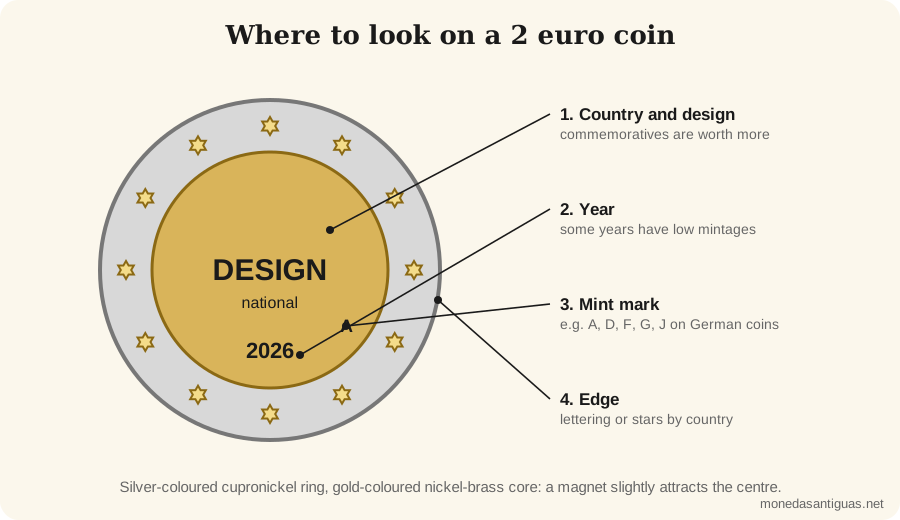
5 Quick Authentication Tests
Perform these tests in order. If a coin fails any test, it's likely counterfeit:
1 The Magnet Test
Why it works: Genuine 2 euro coins have a nickel core (magnetic) and a nickel-brass outer ring (non-magnetic). Most counterfeits get this wrong.
How to test: Hold a small magnet (refrigerator magnet works) to the coin center.
2 Weight Check
Specification: Exactly 8.5 grams (tolerance: ±0.1g)
How to test: Use a digital scale with 0.01g precision (available for €15-20).
3 Diameter Measurement
Specification: Exactly 25.75mm
How to test: Use digital calipers (€10-20) for precision.
4 Edge Lettering Inspection
What to look for: Sharp, clear inscription specific to the issuing country.
How to test: Roll the coin on its edge and read the inscription. Use a magnifying glass if needed.
5 Visual Detail Check
What to look for: Crisp design details, clean separation between ring and center, proper color.
How to test: Compare to a known genuine coin under good lighting. Use 10x magnification.
The Magnet Test Explained
This is the most important test because it's nearly impossible for counterfeiters to replicate the exact magnetic properties of genuine coins.
Why The Bi-Metallic Structure Matters
A genuine 2 euro coin has:
- Center (core): Three-layer structure: Nickel-Brass / Nickel / Nickel-Brass
- Outer ring: Copper-Nickel (75% Cu, 25% Ni)
The nickel layer in the center makes it slightly magnetic. The copper-nickel ring is NOT magnetic. Counterfeits typically use solid metals that are either completely magnetic or not magnetic at all.
Magnet Test Results
| Result | Meaning |
|---|---|
| Center slightly attracted, ring not | ✅ Likely genuine |
| No magnetic attraction at all | ❌ Likely fake - wrong metal composition |
| Strong magnetic attraction | ❌ Likely fake - iron/steel used |
| Ring is magnetic | ❌ Definitely fake |
| Entire coin strongly magnetic | ❌ Definitely fake |
Official 2 Euro Coin Specifications
| Weight | 8.5 grams (±0.1g) |
| Diameter | 25.75mm |
| Thickness | 2.20mm |
| Center composition | Nickel-brass clad nickel (CuNi plated Ni) |
| Ring composition | Copper-nickel (75% Cu, 25% Ni) |
| Edge | Reeded with lettering |
Edge Lettering by Country
Every eurozone country has a unique edge inscription. Knowing what to look for helps identify fakes:
| Country | Edge Inscription |
|---|---|
| 🇩🇪 Germany | EINIGKEIT UND RECHT UND FREIHEIT |
| 🇫🇷 France | 2 ** (repeated) |
| 🇮🇹 Italy | 2 * (repeated) |
| 🇪🇸 Spain | 2 ** (repeated) |
| 🇳🇱 Netherlands | GOD ★ ZIJ ★ MET ★ ONS ★ |
| 🇧🇪 Belgium | 2 ** (repeated) |
| 🇦🇹 Austria | 2 EURO *** (repeated) |
| 🇬🇷 Greece | ΕΛΛΗΝΙΚΗ ΔΗΜΟΚΡΑΤΙΑ * |
| 🇵🇹 Portugal | Five coats of arms separated by stars |
| 🇫🇮 Finland | SUOMI FINLAND *** (three lion heads) |
| 🇮🇪 Ireland | 2 ** (repeated) |
| 🇱🇺 Luxembourg | 2 ** (repeated) |
| 🇻🇦 Vatican | 2 * (repeated, alternating upright/inverted) |
| 🇲🇨 Monaco | 2 ** (repeated) |
| 🇸🇲 San Marino | 2 * (repeated, alternating) |
Edge Lettering Red Flags
- Smooth edge with no inscription = definitely fake
- Blurry or shallow lettering = likely fake
- Wrong text for the country shown = definitely fake
- Misspellings = definitely fake
Visual Inspection Tips
What Genuine Coins Look Like
- Surface: Smooth, even finish with no pitting or rough spots
- Details: Sharp, crisp lines on portraits and symbols
- Bi-metallic join: Clean separation between ring and center
- Color: Golden ring, silver-toned center (may vary slightly with age)
- 12 stars: Evenly spaced, sharp points
What Fakes Often Look Like
- Surface: Rough texture, pitting, visible scratches in design
- Details: Soft, mushy features; lines blend together
- Bi-metallic join: Visible gap, misalignment, or seam
- Color: Wrong shade; too yellow, too white, or uneven
- 12 stars: Uneven spacing, different sizes, blunt points
Grace Kelly Fake Warning
The Most Counterfeited 2 Euro Coin
The Monaco 2007 Grace Kelly coin is the most faked euro coin in existence. For every genuine coin, there are thousands of replicas.
Key Facts About the Real Grace Kelly Coin:
- Mintage: Only 20,001 coins exist
- Never circulated: Only sold in collector cases from Monaco Stamp and Coin Museum
- Original price: €120 in 2007
- Current value: €3,500 - €5,000
- No certificate: The original did NOT come with a certificate
How to Spot Grace Kelly Fakes:
- ❌ Price under €2,000 = almost certainly fake
- ❌ Seller claims "found in change" = fake (it was never in circulation)
- ❌ Comes with "certificate of authenticity" = suspicious (originals didn't have one)
- ❌ Multiple available from same seller = fake
- ❌ Poor detail on Grace Kelly's hair = fake
If buying a Grace Kelly coin: Only purchase from established numismatic dealers with verified provenance. Authentication by NGC or PCGS recommended for any coin over €500.
What To Do With Fake Coins
Legal Warning
Knowingly passing counterfeit currency is a criminal offense in all EU countries. Penalties include fines and imprisonment.
If You Receive a Fake Coin
- Don't try to spend it - This is illegal
- Report it - Take to your local bank, police station, or central bank
- You won't be compensated - Unfortunately, fake coins have no value and cannot be exchanged
- Provide information - Tell authorities where/when you received it
If Buying Collectible Coins
- Buy from reputable dealers - Established numismatic shops, official mints
- Request return policy - Legitimate sellers offer 14-30 day returns
- Get authentication - For coins over €200, professional grading is worthwhile
- Check seller history - On eBay, look for high feedback and specialization
Frequently Asked Questions
How common are fake 2 euro coins?
According to the ECB, counterfeit euros represent a tiny fraction of coins in circulation—less than 0.001%. However, in specific areas (tourist zones, casinos) the rate can be higher. High-value collectible fakes (Grace Kelly, Vatican) are extremely common online.
Can vending machines detect fake 2 euro coins?
Modern vending machines use multiple sensors (weight, diameter, magnetic properties, conductivity) and reject most counterfeits. However, sophisticated fakes occasionally pass. If a machine rejects your coin, it doesn't necessarily mean it's fake—machines can malfunction.
Are there fake coins from foreign countries that look like 2 euros?
Yes. The Turkish 1 Lira, Thai 10 Baht, and Egyptian 1 Pound coins have similar size/weight to 2 euros and are sometimes used fraudulently. These aren't "counterfeits" technically, but using them as 2 euros is illegal.
Should I buy a coin tester?
For casual use, a magnet and digital scale are sufficient (total cost: €20-30). Electronic coin testers (€50-200) are useful for businesses or serious collectors handling large volumes.
What if I'm not sure if my coin is real?
Take it to any bank. They can verify authenticity with professional equipment. If genuine, you keep your coin. If fake, they'll confiscate it (no compensation, but no legal trouble if you didn't know).
Related Guides
📚 More Resources